
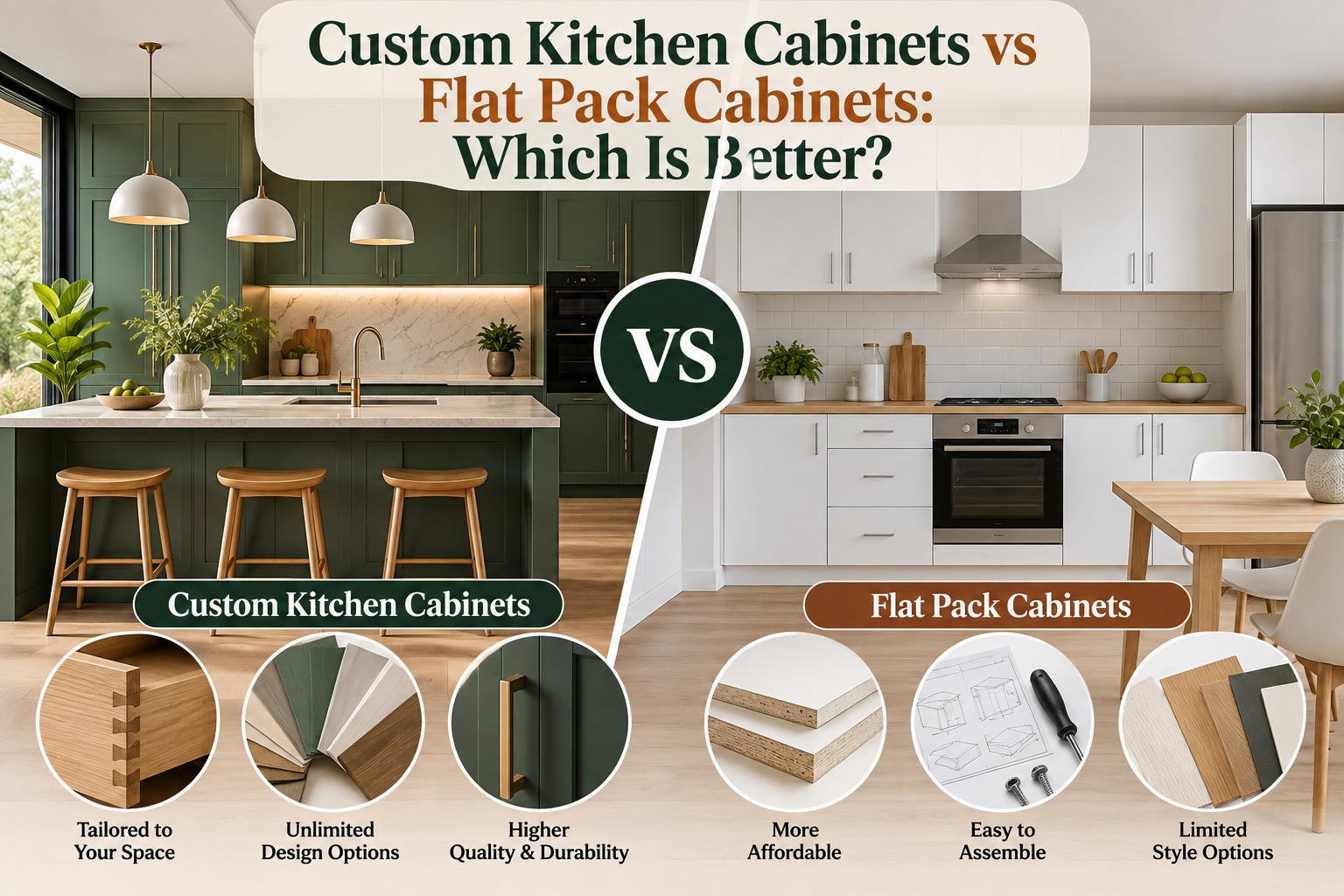
Custom Kitchen Cabinets vs Flat Pack Cabinets: Which Is Better?
A flat pack kitchen is just like a custom kitchen the day of the installation. Wait three years and you’ll know which one you bought!
That’s the part most comparison articles skip. They talk about price on day one and stop there, when the real difference shows up in how a cabinet door hangs after a thousand open-and-close cycles, or whether a drawer still runs smooth once the kids are old enough to slam it.
So here’s an honest look at custom kitchen cabinets vs flat pack cabinets, from someone who builds one of them for a living.
What Flat Pack Cabinets Actually Are
Flat Pack Cabinets are panels that are flat packed in standard sizes (typically 600mm, 900mm and 1200mm) and arrive at the job site ready to assemble. They are assembled on location by you or a tradie.
The appeal is real:
- Lower upfront cost
- Faster turnaround, often installed within a week or two
- A genuine DIY option if you’re handy with a drill
The majority of flat pack carcasses are melamine faced particleboard or MDF. Yes, it is a great material to be used for a rental or for a quick refresh, but it is not a material for a kitchen that you will use daily for 20 years.
What Custom Cabinets Actually Are
Custom Cabinets are manufactured according to the size of the kitchen, rather than the cabinet size dictating the size of the kitchen. Each panel, drawer and door has been created for your walls, ceiling height and appliances.
It also involves HMR particle board or plywood carcasses (not trimmed on site), soft-close hinges and runners that endure tens of thousands of open/close cycles. Edge banding is hot and pressure-molded to the edge of the board and not cut. Expensive up-front. It’s also designed to carry on serving its purpose in 15 years, not 5.
Head to Head: The Four Things That Really Work
Upfront Cost
Flat pack wins here, no argument. Supply-only flat pack cabinetry in Australia typically starts in the low thousands, while a fully custom kitchen usually lands somewhere in the five figures depending on size and finish.
That gap is real. If you’re fitting out a rental or working to a tight budget, it matters.
How Well It Actually Fits Your Kitchen
This is where the flat pack starts to struggle. Standard sizing works brilliantly in a new-build with square walls and a flat ceiling, less so in a 1920s Mount Lawley bungalow with a wall that’s 15mm out of true.
- Flat pack: filler panels, visible gaps, cabinets that stop short of an uneven ceiling
- Custom: built to the millimetre, including around that dodgy wall
If your home has any character to it, this one point alone can decide the whole debate.
Durability
Flat pack hardware wears the great first couple of years. At about the age of 3 or 4, the hinges begin to become loose, and the runners of the drawers lose tension, particularly where they’re close to the sink and dishwasher, where moisture has a way of working its way into the board.
But with good soft-close hardware and moisture-resistant board, it doesn’t follow that curve when it comes to custom cabinetry. It was designed to be as comfortable on day 3,000 as it was on day one.
Timeline
Flat pack is fast. You could be assembling boxes within a week of ordering.
Custom will take longer, typically weeks from design to installation, since they’re not coming off the shelf and are being made to fit your kitchen.
So, Which One Should You Actually Choose?
Flat pack probably makes sense if:
- You’re renovating a rental or investment property
- Your kitchen has standard, square dimensions
- Budget is the deciding factor and you’re comfortable revisiting it in five to ten years
Custom probably makes sense if:
- This is the kitchen you’ll use every day for the next decade or more
- Your home has any non-standard walls, angles or ceiling heights
- You want it done once, properly, without a second renovation down the track
The Real Question
The cheapest kitchen on install day isn’t always the cheapest kitchen over ten years. Once you factor in the odd hinge repair or a drawer runner replacement, the gap between flat pack and custom tends to close more than people expect.
That doesn’t make flat pack the wrong call. It’s genuinely the right one for plenty of homes and budgets. It just means the decision is worth making with your eyes open, not just your wallet.
If you want an honest opinion on which one suits your kitchen, drop into our workshop in Canning Vale, have a look through our portfolio at millerelabine.com.au, or get in touch for a straightforward, no-pressure quote. We’ll give you a straight answer, even if that answer is “flat pack’s fine for this one.”